How Leonardo Painted the Last Supper: Technique, Secrets and Restoration

Travel Analysts
📄How did Leonardo paint the Last Supper? The experimental technique, why it started decaying immediately, and how much of the original masterpiece survives today.

💡Quick Answer
Leonardo didn't paint the Last Supper as a traditional fresco — he experimented with tempera and oil on a dry wall, giving him more control but dooming the work to rapid decay. Today, only about 20% of the visible surface is original Leonardo. What you see is both a Renaissance masterpiece and 500 years of damage, restoration, and scientific rescue.
Explore the full guide & expert tips ➜Leonardo’s Technical Gamble: Painting Like a Panel on a Wall
Leonardo approached The Last Supper as a bold technical experiment. Instead of painting true fresco on wet plaster, he chose to work on a dry wall, preparing it with multiple sealing and ground layers so it would behave more like a wooden panel. This allowed him to paint slowly, revise details, and build subtle transitions of light and shadow—something almost impossible with traditional fresco.
On top of this prepared surface, Leonardo used tempera and likely oil-based binders, effectively attempting to translate panel-painting techniques to masonry. The advantage was extraordinary control: faces, hands, drapery, and light effects could be reworked until they reached the psychological intensity he wanted. The risk was structural. Because the pigments did not chemically bond with wet plaster, the paint layer was fragile from the moment it dried.
Why the Painting Started Deteriorating So Quickly
The technical choice that gave Leonardo freedom also sealed the painting’s fate. Contemporary accounts already mention deterioration within a few decades of completion, with flaking, fading, and loss of brilliance noted by early visitors. The refectory wall itself was problematic: humidity, temperature fluctuations, and moisture rising through the masonry constantly stressed the paint layer.
Leonardo’s sealing layers, designed to stabilize the surface, actually trapped moisture inside the wall instead of letting it evaporate. Over time, the wall “wept” behind the paint film, weakening adhesion and accelerating decay. Environmental damage was compounded by later structural changes to the building, including alterations that physically removed parts of the lower section of the mural and destabilized already compromised areas.
Perspective, Architecture, and the Illusion of Space
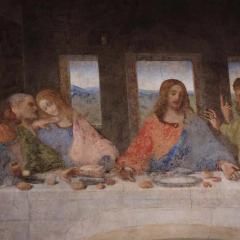
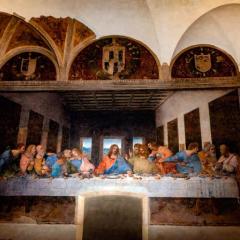
Despite its material fragility, The Last Supper is a triumph of compositional intelligence. Leonardo used single-point linear perspective with all major orthogonals converging at Christ’s head, making it both the visual and spiritual center of the scene. The painted architecture mirrors the real refectory, aligning ceiling lines and side walls so the illusion extends the actual dining hall into the pictorial space.
This alignment was deliberate. The monks eating in the refectory would have felt as though Christ and the apostles shared their space, reinforcing the spiritual meaning of the scene. The table becomes a boundary between the real and painted worlds, anchoring the drama directly in the viewer’s environment.

Light, Gesture, and the Psychological Drama
Leonardo pushed chiaroscuro on a scale rarely attempted in mural painting. Working on a dry surface allowed him to layer thin tones, modeling faces and hands with a softness closer to oil painting than fresco. This subtle handling of light gives the figures volume and emotional presence.
The real narrative power lies in the gestures. The apostles react in rhythmic groups to Christ’s announcement of betrayal—some recoil, some argue, some turn inward. Hands point, clench, and reach, functioning almost like a silent script. Each figure responds differently, creating controlled chaos around the stillness of Christ at the center.
What Scientific Analysis Has Revealed
Modern scientific studies—including multispectral imaging and pigment analysis—confirm that Leonardo built the mural in numerous thin layers over a carefully engineered ground. These investigations reveal small adjustments beneath the visible surface: shifts in hand positions, facial angles, and folds of drapery, consistent with Leonardo’s habit of revising as he worked.
Equally important, science has helped conservators distinguish original Renaissance material from centuries of later repainting. Mapping where authentic pigment survives versus where later hands intervened was essential for any responsible restoration, especially given how extensively the surface had been altered over time.

Early Restorations: When “Repair” Meant Repainting
By the mid-16th century, some observers were already calling the mural a ruin. From the 18th century onward, restoration efforts often focused on repainting damaged areas rather than stabilizing what remained. Entire sections were overpainted to “improve” legibility, gradually burying Leonardo’s subtle transitions under heavier brushwork and varnish.
Each new intervention layered over previous ones, turning the wall into a complex palimpsest. By the 20th century, art historians debated whether what remained was still meaningfully Leonardo’s work or a composite shaped by generations of well-intentioned but damaging repairs.
The 1978–1999 Restoration: Method and Controversy
The most ambitious modern restoration took place between 1978 and 1999. Its goal was not to recreate the painting’s original appearance, but to remove non-original material, stabilize surviving pigment, and halt further decay. Conservators worked millimeter by millimeter under microscopes, using carefully calibrated solvents to strip later layers without damaging Renaissance paint beneath.
Where original paint was lost, restorers filled gaps with neutral tones and light cross-hatching, avoiding full reconstruction. From a distance, the composition reads coherently; up close, losses remain visible as deliberate lacunae. Climate control and structural stabilization were also improved, acknowledging that the mural could never be “fixed,” only preserved in a fragile equilibrium.
The project sparked fierce debate. Critics argued it produced a ghostly, fragmented image—a “Lost Supper.” Supporters countered that preserving clearly identifiable original material, even if incomplete, is more honest than presenting a visually pleasing but largely inauthentic repaint.
How Much of the Last Supper Is Actually Leonardo Today?
Estimates vary, but many scholars suggest that only a small fraction of the visible surface—often cited around 20 percent—can be confidently attributed to Leonardo’s hand. The rest consists of exposed underdrawing, abraded surfaces, neutral fills, and traces of earlier restorations.
Yet the power of the work remains. Details recovered during restoration—subtle modeling in faces, the transparency of glassware, the balance of color across the table—offer rare glimpses into Leonardo’s original intentions. What survives is enough to understand why the painting changed the course of Western art.
A Masterpiece and a Document of Loss
Today, The Last Supper is both a masterpiece and an archaeological object. You are looking at Leonardo’s composition and surviving passages of his technique, but also at five centuries of damage, error, repair, and scientific rescue. Its current state tells two intertwined stories: the brilliance of an artist who pushed technique beyond its limits, and the long struggle to preserve what time nearly erased.
About the Author
Intercoper Curator Team
Travel Analysts
The editorial team at Intercoper researches, verifies, and curates the best tour experiences in Milan and across Europe's most visited landmarks and museums.
❓ Frequently Asked Questions
Our recommended Last Supper Tours


The Last Supper Has the Highest Markup in European Tourism: 10.7xHow to Buy Official Last Supper Tickets (Step-by-Step Guide)Last Supper Milan Tickets: Prices, Types and Discounts ExplainedLast Supper Milan Tickets Sold Out: What To Do NextIs the Last Supper Worth It? Honest Pros, Cons and Alternatives in MilanBest Guided Tours in Milan: Last Supper and Duomo in One DayCommon Mistakes to Avoid When Booking Last Supper Tickets and ToursHow to Visit the Last Supper in Milan in One Day: Itineraries from the Duomo and Central StationLeonardo da Vinci in Milan: Complete Guide to All SitesAccessible Last Supper Tour: Wheelchair Access and Low-Mobility TipsHow Leonardo Painted the Last Supper: Technique, Secrets and RestorationLast Supper and Lake Como Day Trip: Is It Possible?Small Group vs Private Last Supper Tours: Which Is Best?What to Wear to See the Last Supper and the Duomo in Milan
Tours for this guide
Prices updated this week
 Art Historian Last Supper Tour Milan Tickets$190
 Leonardo Last Supper Art History Expert Milan$100
 Da Vinci Last Supper Art Expert Guided Tour$89